Monthly Report: Clara Trevisan (June 2026)
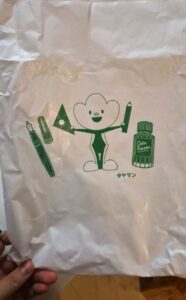
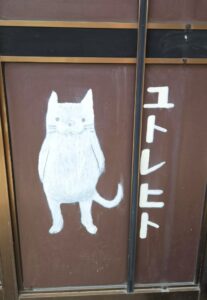
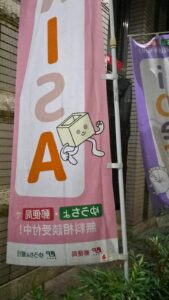
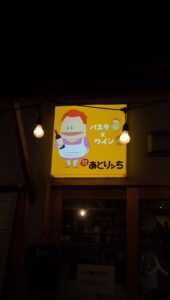
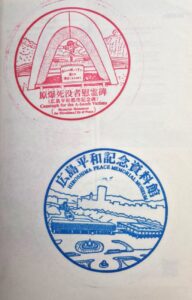
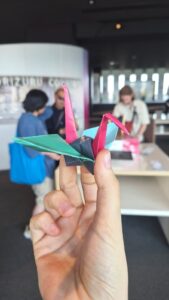
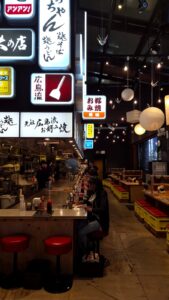
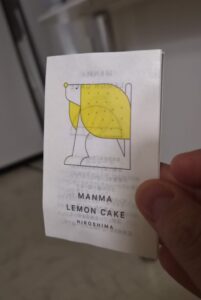
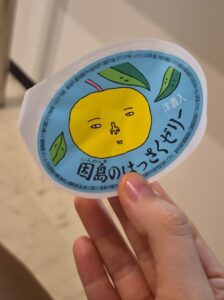
Our first week in Hiroshima was already very intense and informative. Hosted by Ryuji-san and Shinya-san, we started to get to know more about the city with a visit to the Hiroshima Memorial Peace Museum. It was a heavy, but necessary tour, in order to better understand the trauma, the collective strength and the rebuilding that led to the city that now exists. I was impressed that only 12 years after the bomb, the city was back to the point of already having a Baseball Stadium built. Next, we headed to the Orizuru Tower, where we could have an amazing panoramic view of the city, and got to leave our wishes in the shape of paper cranes. I was amazed by the amount of green mountains around Hiroshima, a view I hadn’t really acknowledged until I was on the top of the tower. It was also fun to go down the floors through the slide! After that, we got to try Okonomiyaki (a bit heavy for me) and watch a Kagura performance. It was beautiful, and very accessible to foreigners with projected subtitles. Not only the choreography, but the music and the beautifully crafted costumes caught my attention during the whole story. It felt like the cautionary tales presented in theatrical street performances I grew up watching. I found out Hiroshima Prefecture is the biggest lemon producer in Japan - from that moment on, I saw lemon themes around almost every day (lucky me, I love citric fruit). I also started to observe how the logos, characters and design overall of graphic pieces are amazing and creative, so I’ve been registering many of those too.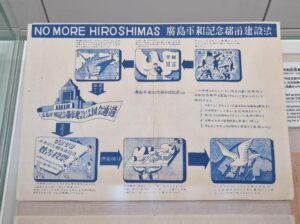
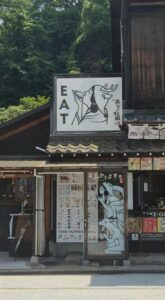
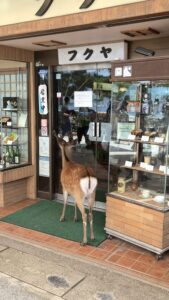
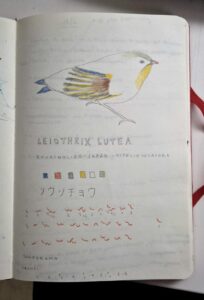
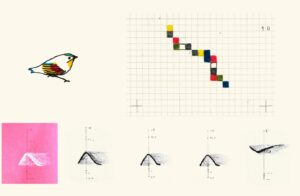
In the next day, we had a trip to Miyajima, which I was looking forward to. I felt very happy to be able to see the deer from up close, beautiful moss, lizards, mountains, many shrines and temples and even a giant wasp that hit our ropeway car. Through the app Merlin, I also identified a couple of birds through their song, which later became a part of the diagram I started developing. By the end of the day, we could see the gorgeous Itukushima Shrine and it’s Torii floating in water, with the rise of the tide in the afternoon. Hiroshima smells like sea.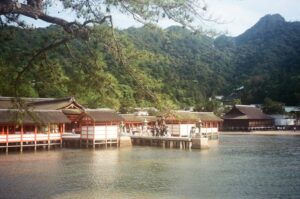
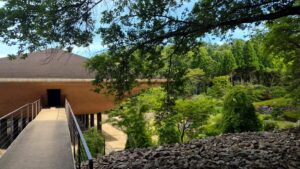
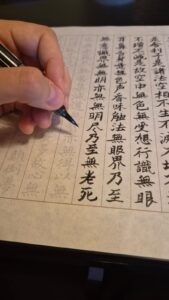
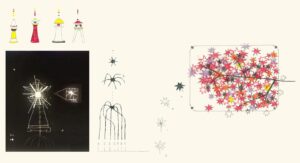
Two days later, we had a zen experience day in Shinshoji Zen Museum, which was intensely memorable. The place was beautiful and peaceful. The maple leaves, resembling a billion tiny stars on trees, caught my attention. I had never seen Maple trees, and they ended up also becoming an element for the diagram. We practiced calligraphy, zen meditation, had great tea and visited one of the most impressive installations I’ve ever witnessed, by artist Kohei Nawa in Kohtei Art Pavillion. I wouldn’t be able to describe it shortly, since it was deeply sensorial, but the experience made me think deeply about Hiroshima’s connection to water and light.
In the next day, we visited the Hiroshima MOCA (it had an exhibition about Finnish Sauna), 2 small and very charming art galleries(gallery G、TAMENTAI Gallery), Animate store and the amazing Motomachi Apartments project, a social housing complex dated from the post-war times. Just outside the MOCA, we got lucky to get a call in the Earth Call - Hiroshima installation, from artist Atsuo Okamoto, and talked to a teenager from a place close to Tokyo.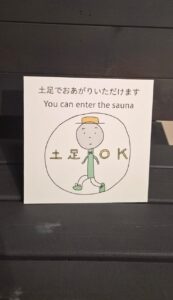
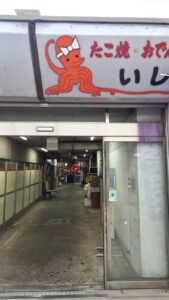
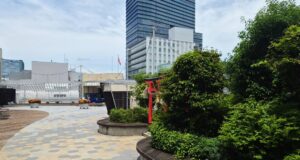
After these very intense and full days, I started processing the arrival, and all the information I got, and began organizing my own research. I re-read The Author of the Acacia Seeds, from Ursula K. Le Guin, to get my thoughts moving, and started visiting shrines around the area we’re staying in. So far, I have visited over 20 shrines in Hiroshima and surroundings. From all of those, two stuck in my mind because of their peculiarity: Fukuya Inari Shrine, which is placed in the 9th floor of Fukuya Department Store - a very curious place for a shrine, and the Higashi Shintenshi Inari Shrine, placed in a very narrow alley of the bohemian quarters of the city. The curious placements of these two altars represent very clearly to me the shinto view that the kami are everywhere. 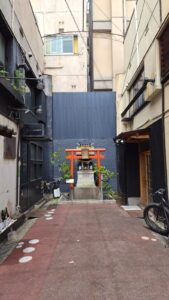
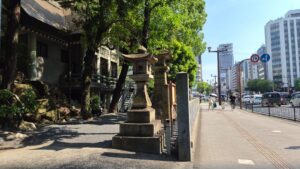
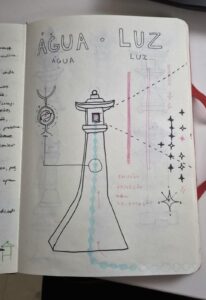
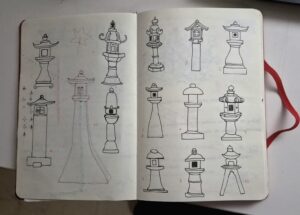
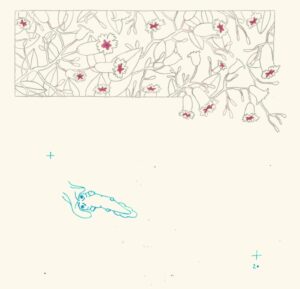
The first shrine, though, that caught my attention, was Shirakami Shrine, located in a busy crossing of Peace Boulevard. The shrine originated in a time where that ground was a piece of reef in the Hiroshima delta, serving as reference point to ships, through erecting white paper as a low-tech lighthouse. It has a tall stone lighthouse in the front, as a symbol of its nautical origins. I observed, from my many visits to shrines, that the majority of them, in Hiroshima, are dedicated to kami connected to fishing, ships and the sea, which made me conclude that it was essential to represent water in the work I was developing. From my research I also got to know Amaterasu, kami of the sun, who is very important in the Shinto pantheon, and made me feel like it would be important to also represent light. I started, then, to draw the many shapes of stone lanterns I found in the shrines and temples, which led to an animation connecting water and light through these objects. Afterwards, I thought about how to connect the water-light animation with the maple leaves, and how to represent water. This led me to a couple more animations, and the inclusion of the catfish as a representative of water, after getting to know the Namazu legend. I also did some research on the songbird I identified in Miyajima, the Red-billed Leiothrix, and found its sonogram. I had never seen bird songs registered visually like that, so I decided to explore it through animation. Besides these elements, I also added a pair of Komainu, guarding creatures usually placed in the entrance of shrines, to protect the diagram, and the Hekusokazura flower, that I saw along the riverbanks, a native stinky plant that blooms in summer. I’m still investigating this one.
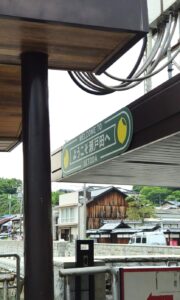
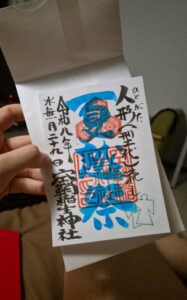
Besides all the nice places we visited during the first week, we also got to go twice to Onomichi, the first time in a bike ride through the islands, finishing in Setoda. We got to try the unforgettable Hassaku Daifuku, which I must find again. We’ve visited two summer festival events (Nagoshi-no-Oharae at Sorasaya Shrine and Shirakami Shrine), participated in the purification rituals and watched fireworks by the river. Without any doubt, a very dense and rich first month!